AI overview
The goal of Artificial Intelligence (AI) is to mimic intelligent behavior in a machine.
Relationship between AI, machine learning, and deep learning
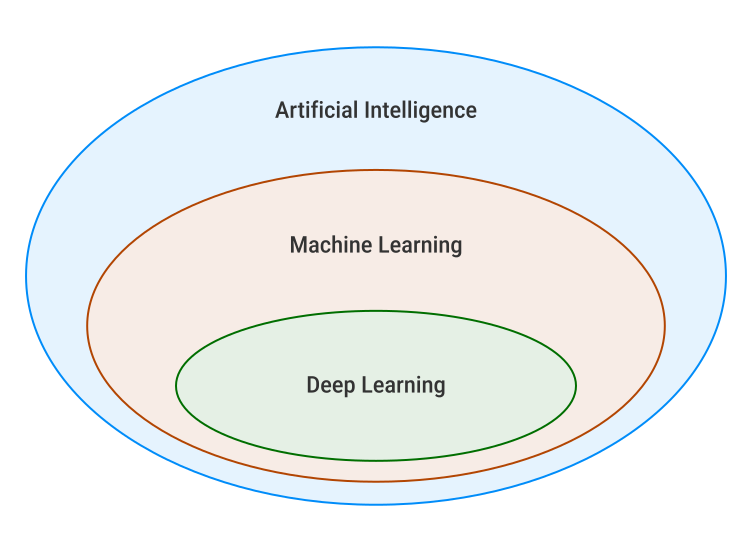
- AI (artificial intelligence):
- broadest concept
- includes old-school algorithms developed from the 1950s onward
- machine learning
- subset of AI
- focuses on systems that learn from data instead of being explicitly programmed
- deep learning
- subset of machine learning
- uses neural networks with many layers
Machine learning
Machine learning involves three steps:
- identifying what information we want
- collecting relevant data
- designing algorithms to extract insights from that data
Machine learning started with expert systems and later evolved into three main learning approaches:
- supervised learning
- the computer is trained using labeled data: pairs of inputs and their correct human-provided labels
- the system learns patterns that link inputs to labels
- it can then predict the correct label for new unseen inputs
- unsupervised learning
- the computer is trained with data that has no labels
- the system learns relationships within the data itself, rather than between inputs and labels
- reinforcement learning
- the computer is trained to make decisions through trial and error
- the system receives rewards or scores for its actions
All models are wrong, but some are useful. George Box
Advances in AI are driven by three main factors
More speed
Faster machines and specialized chips, originally built for graphics, now power modern AI systems.
GPUs (graphics processing units):
- can perform the same operations as CPUs but simultaneously
- GPU makers like NVIDIA realized this early and are developing GPUs for deep learning
Until the advent of fast GPUs, computers were too slow to train neural networks.
Better algorithms
The training process was incompletely understood.
That changed over the decades with key algorithmic innovations:
- activation functions
- backpropagation
- batch normalization
- dropout
- gradient descent
- network initialization
Huge amounts of data
Models learn from data; the more the better because more data means an improved representation of what the model will encounter when used.
The tremendous growth of the web allowed an explosion of data. Companies such as Google (DeepMind), Meta, Amazon, and Apple collect enormous amounts of user data in exchange for their services.
In machine learning, data is everything.
 Joint
Joint