Routing algorithms
Routing is a top 10 networking challenge.
The goal of a routing algorithm is to find good paths (or routes) for data to travel from senders to receivers through a network of routers.
A good path is the one with the lowest cost, although real-world constraints (like policy rules) can also affect the choice.
Modeling the network
Routing problems are represented using graphs where:
- nodes = routers
- two nodes are neighbors if they share a direct link
- edges or links = physical links between routers
- edges are undirected (traffic can go both ways)
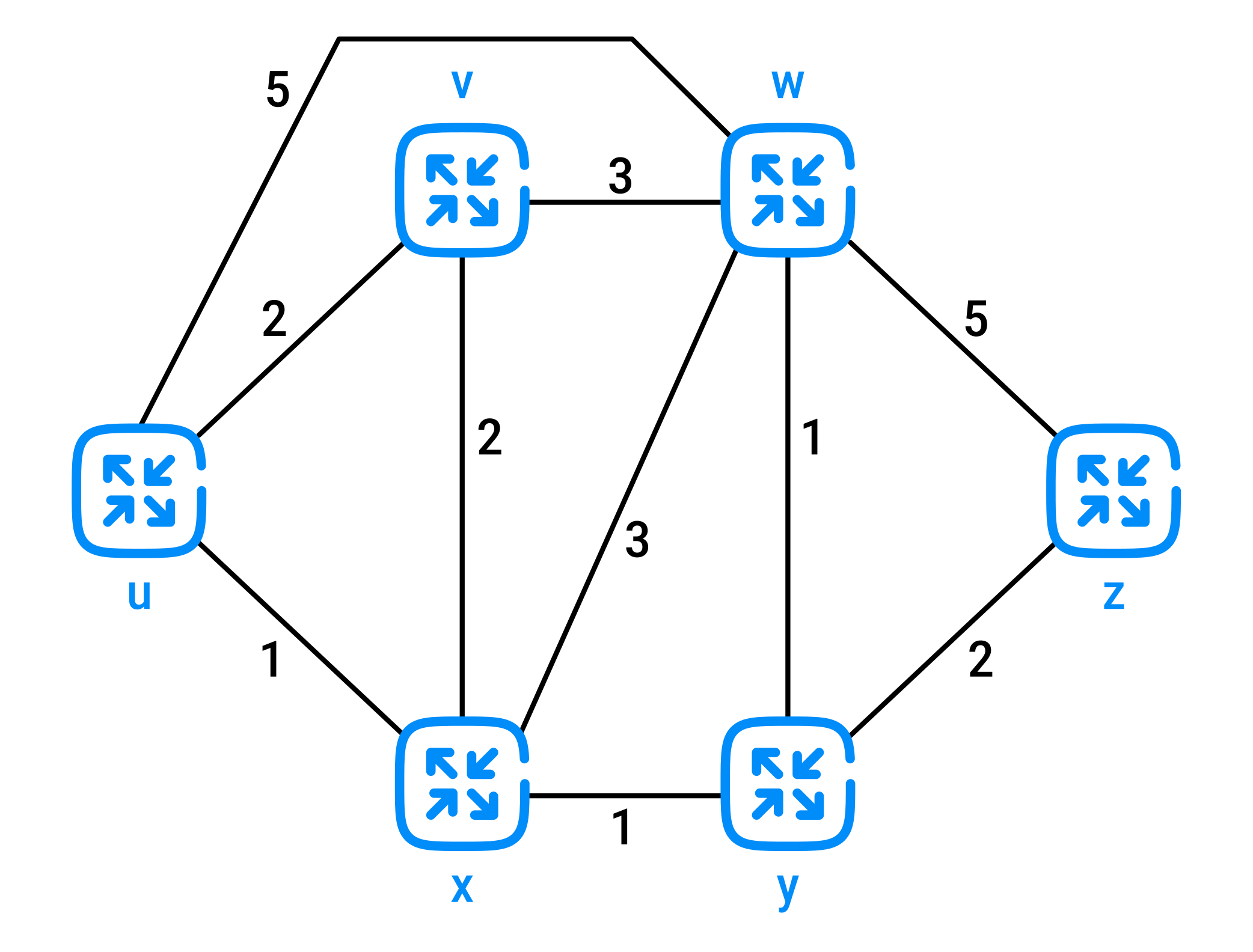
The cost of an edge between two nodes x and y is:
\[ c(x, y) \]
The cost may represent:
- distance
- speed of the link
- financial cost
Paths
A path is a sequence of nodes connected by links:
\[ (x_{1}, x_{2}, …, x_{p}) \]
The cost of a path is the sum of all edge costs along it:
\[ c(x_{1}, x_{2}) + c(x_{2}, x_{3}) + … + c(x_{p - 1}, x_{p}) \]
Between any two nodes, there may be many possible paths. The least-cost path is the one with the smallest total cost.
If all links have equal cost, the least-cost path is simply the shortest path (fewest hops).
Types of routing algorithms
Routing algorithms are classified in several ways:
| Classification | Type | Description |
|---|---|---|
Centralized vs. decentralized |
Centralized (link-state) |
|
Decentralized (distance-vector) |
|
|
Static vs. dynamic |
Static routing |
|
Dynamic routing |
|
|
Load-sensitive vs. load-insensitive |
Load-sensitive |
|
Load-insensitive |
|
Fundamental routing algorithms
Two main classes of routing protocols are used to compute least-cost paths in a network:
- link-state (LS) routing protocols
- distance-vector (DV) routing protocols
Neither algorithm is an obvious winner over the other:
- LS converges faster and avoids some DV pathologies, but it requires more memory, computation, and flooding overhead
- DV generally requires less information exchange per update but can suffer from slower convergence and problems such as count-to-infinity
Both are used in the Internet. For example, OSPF is a link-state protocol, while RIP is a distance-vector protocol.
They are used in both traditional per-router control and SDN architectures.
 Joint
Joint