Generalized forwarding and SDN
Earlier, we described destination-based forwarding as two steps:
- match: find the destination IP address
- action: send the packet through the switching fabric to the correct output port
The match-plus-action pattern
This "match-plus-action" pattern is widely used in networking devices:
- match can use:
- multiple header fields
- different protocols
- different layers of the network stack
- action can include:
- forwarding to one or more output ports (as in destination-based forwarding)
- sending traffic across multiple links for load balancing
- changing header values (as in NAT)
- dropping packets (as in a firewall)
- sending packets to a special server for deeper inspection (e.g., DPI)
In this generalized model: a match-plus-action table extends the traditional forwarding table used in destination-based routing.
Devices that use this approach are called programmable or flow-based packet switches, because they can make decisions using both network-layer and link-layer addresses. This term is increasingly used instead of just layer 3 "routers" or layer 2 "switches".
These match-and-action capabilities are controlled by a remote SDN controller that computes, installs, and updates match-plus-action tables in each packet switch.
OpenFlow
OpenFlow helped introduce the match-plus-action model and played a major role in the development of SDN.
Each rule in the match-plus-action forwarding table (known as a flow table entry in OpenFlow) includes:
- match fields:
- header values to which an incoming packet will be matched
- packets that match nothing may be dropped or sent to the controller for more processing
- counters:
- updated as packets are matched to flow table entries
- might include:
- the number of packets that have been matched by that table entry
- the time since the table entry was last updated
- actions:
- forward to a port
- drop the packet
- copy to multiple ports
- rewrite selected header fields
- etc.
Match
In OpenFlow 1.0, a match-and-action rule can match:
- 11 packet-header fields
- and the incoming port number

OpenFlow's match abstraction:
- allows for a match to be made on selected fields from three layers of protocol headers (thus defying the layering principle)
- allows forwarding on the basis of Ethernet addresses rather than IP addresses
As a result, an an OpenFlow-enabled device can act as:
- a router (layer-3 device) forwarding datagrams
- a switch (layer-2 device) forwarding frames
Originally, OpenFlow 1.0 supported 12 match fields. Later versions introduced a much more flexible and extensible match structure rather than a fixed count of fields.
Action
Each flow table entry contains a list of zero or more actions that are applied to matching packets.
Possible actions are:
- forwarding:
- send to a specific output port
- broadcast to all ports except the incoming one
- multicast over a selected set of ports
- dropping:
- no action indicates that a matched packet should be dropped
- modify-field:
- change packet header values before forwarding
OpenFlow examples of match-plus-action
To show how flexible generalized forwarding is, consider a network with:
- 6 hosts
- 3 packet switches (each with 4 interfaces)
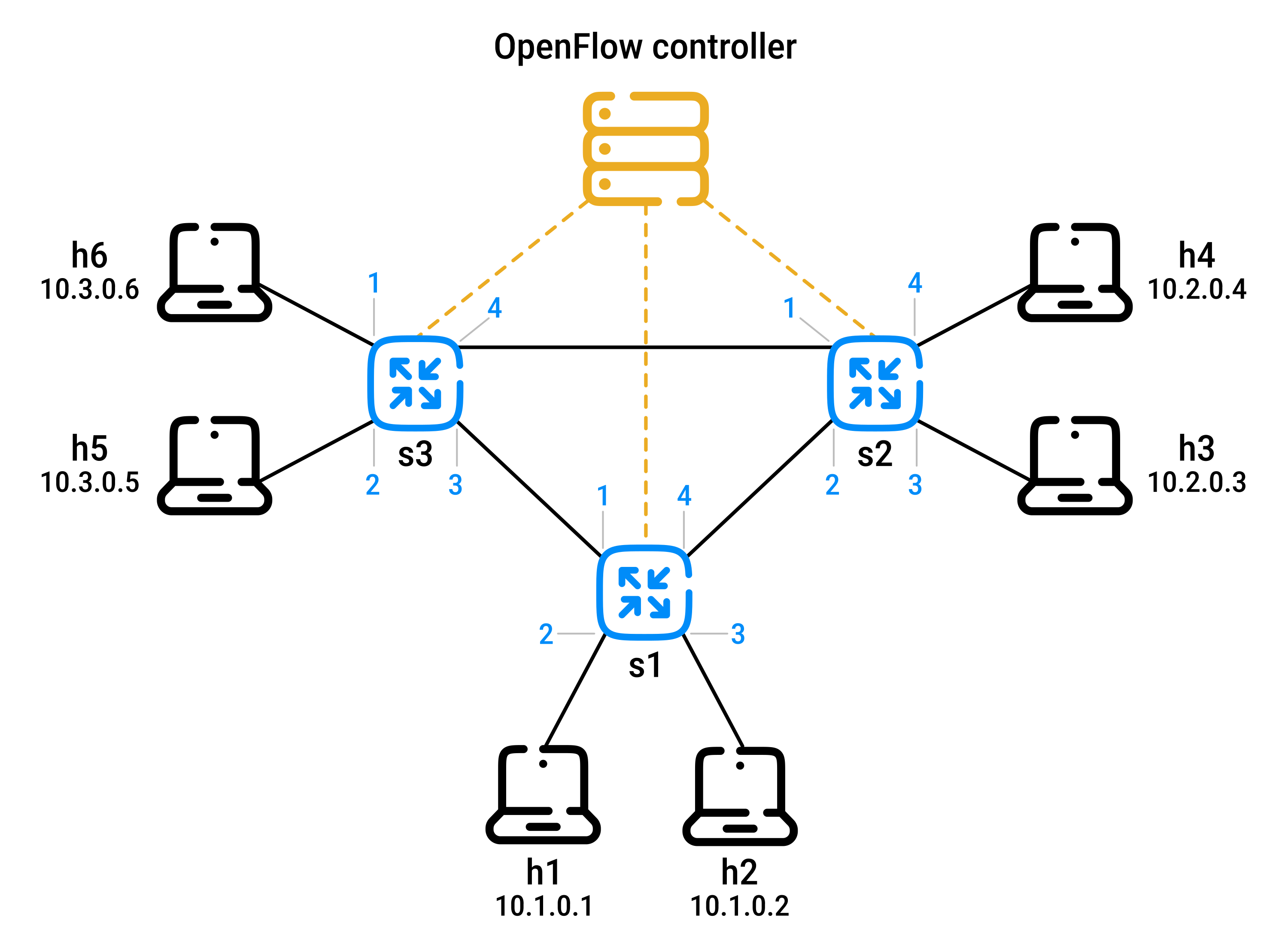
Simple forwarding
Goal:
- packets from
h5orh6destined toh3orh4 - should go
s3 → s1 → s2 - and avoid the direct link between
s3ands2
Flow table entry in s3:
Match                                                       Action
IP Src = 10.3.*.* ; IP Dst = 10.2.*.*                       Forward(3)
Flow table entry in s1:
Match                                                       Action
Ingress Port = 1 ; IP Src = 10.3.*.* ; IP Dst = 10.2.*.*    Forward(4)
Flow table entry in s2:
Match                                                       Action
Ingress port = 2 ; IP Dst = 10.2.0.3                        Forward(3)
Ingress port = 2 ; IP Dst = 10.2.0.4                        Forward(4)
Load balancing
Goal:
- traffic from
h3destined to10.1.*.*uses links2 → s1 - traffic from
h4destined to10.1.*.*uses links2 → s3 → s1 - (this couldn't be achieved with IP's destination-based forwarding)
Flow table entry in s2:
Match                                                       Action
Ingress port = 3; IP Dst = 10.1.*.*                         Forward(2)
Ingress port = 4; IP Dst = 10.1.*.*                         Forward(1)
Additional rules are needed:
- at
s1to forward the datagrams received froms2to eitherh1orh2 - at
s3to forward datagrams received on interface4froms2over interface3towards1
Firewalling
Goal:
s2should only accept traffic from hosts connected tos3(10.3.*.*)
Flow table entry in s2:
Match                                                       Action
IP Src = 10.3.*.* IP Dst = 10.2.0.3                         Forward(3)
IP Src = 10.3.*.* IP Dst = 10.2.0.4                         Forward(4)
If no other rules exist: all other traffic is effectively blocked.
 Joint
Joint