The three most influential paper size standards worldwide are ISO 216, JIS P 0138 and ANSI:
| Standard | Origin | Units | Aspect Ratio | Series / Sizes | Geographic Use | Notes |
|---|---|---|---|---|---|---|
| ISO 216 | Germany (DIN 476) | Metric | Constant 1:√2 |
A, B, C series | Most of the world |
|
| JIS P 0138 | Japan | Metric | Constant 1:√2 |
A, B series; specialty sizes | Japan |
|
| ANSI | United States | Inches | Varies | Letter, Legal, Tabloid, etc. | United States |
|
The mathematics of paper size
The ISO 216 format is governed by three principles:
- halving: each size is half the area of the previous one
- proportionality: pages can be cut in half without changing their shape
- similarity: documents can be enlarged or reduced without reformatting
All three principles follow from a single invariant: every page has the same irrational 1:√2 aspect ratio (first noted by Lichtenberg in 1786).
The "one to square root of two" aspect ratio
Aspect ratio is the ratio of an image's width to its height, expressed as width:height.
The 1:√2 aspect ratio translates to \( \frac{width}{height} = \frac{1}{\sqrt{2}} \).
Put simply, a page with a width of 1 unit has a height of √2 units:

Height-width relationship
From that point, even though it's fairly straightforward, we can deduce that the height equals the width multiplied by √2:
\[\begin{aligned} \frac{width}{height} &= \frac{1}{\sqrt{2}} \\ \frac{width}{height} {\color{crimson} \times height} &= \frac{1}{\sqrt{2}} {\color{crimson} \times height} \\ width &= \frac{height}{\sqrt{2}} \\ width {\color{crimson} \times \sqrt{2}} &= \frac{height}{\sqrt{2}} {\color{crimson} \times \sqrt{2}} \\ height &= width \times \sqrt{2} \\ \end{aligned}\]
Example: A4 paper
- width = 210
- height = 210 × √2 ≈ 297
- this matches the standardized A4 dimensions of 210 × 297 mm where sizes are neatly rounded

Height-to-width ratio
The ratio expressed the other way:
\[\begin{aligned} height &= width \times \sqrt{2} \\ \frac{height}{{\color{crimson} width}} &= \frac{width \times \sqrt{2}}{{\color{crimson} width}} \\ \frac{height}{width} &= \sqrt{2} \approx 1.414 \\ \end{aligned}\]
So, the height of an ISO A-series page is about 1.414 times its width.
Why √2 is special
When a page is cut in half parallel to its shorter side, the resulting pages keep the same proportions.
Let the original page have:
- width = \( w \)
- height = \( h \)
- height-to-width ratio = \( \frac{h}{w} \)
After cutting it in half:
- new width = \( \frac{h}{2} \)
- new height = \( w \)
- new height-to-width ratio = \( \frac{w}{\frac{h}{2}} \)

For the pages to remain proportional, these ratios must be equal:
\[\begin{aligned} \frac{h}{w} &= \frac{w}{\frac{h}{2}} \\ \frac{h}{w} &= \frac{2w}{h} \\ \frac{h}{w} {\color{crimson} \times h} &= \frac{2w}{h} {\color{crimson} \times h} \\ \frac{h^2}{w} &= 2w \\ \frac{h^2}{w} {\color{crimson} \times w} &= 2w {\color{crimson} \times w} \\ h^2 &= 2w^2 \\ \frac{h^2}{{\color{crimson}w^2}} &= \frac{2w^2}{{\color{crimson}w^2}} \\ \left( \frac{h}{w} \right)^2 &= 2 \\ \frac{h}{w} &= \sqrt{2} \\ \end{aligned}\]
√2 is the only value that satisfies this condition and preserves proportions during halving.
Halving and similarity
Because of the 1:√2 ratio:
- folding or cutting paper in half preserves its proportions
- each size is exactly half the area of the previous one
The A-number represents how many times the page has been folded (or cut) from A0:
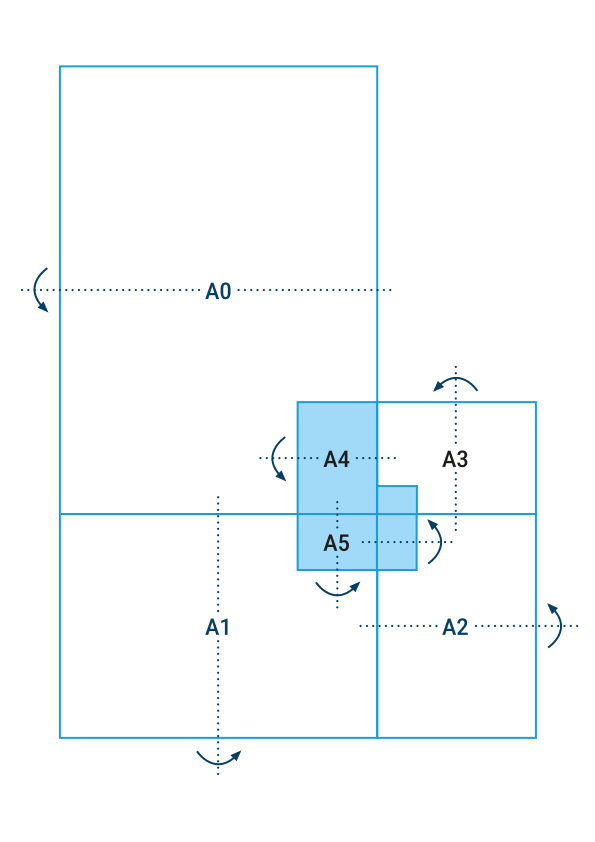
Because proportions are preserved, enlarging or reducing documents between sizes requires no cropping or distortion:

ISO A, B series and JIS B series

| ISO A Series | ISO B Series | JIS B Series・B判 | |||
|---|---|---|---|---|---|
| A0 | 841 × 1189 | B0 | 1000 × 1414 | B0 | 1030 × 1456 |
| A1 | 594 × 841 | B1 | 707 × 1000 | B1 | 728 × 1030 |
| A2 | 420 × 594 | B2 | 500 × 707 | B2 | 515 × 728 |
| A3 | 297 × 420 | B3 | 353 × 500 | B3 | 364 × 515 |
| A4 | 210 × 297 | B4 | 250 × 353 | B4 | 257 × 364 |
| A5 | 148 × 210 | B5 | 176 × 250 | B5 | 182 × 257 |
| A6 | 105 × 148 | B6 | 125 × 176 | B6 | 128 × 182 |
| A7 | 74 × 105 | B7 | 88 × 125 | B7 | 91 × 128 |
| A8 | 52 × 74 | B8 | 62 × 88 | B8 | 64 × 91 |
| A9 | 37 × 52 | B9 | 44 × 62 | B9 | 45 × 64 |
| A10 | 26 × 37 | B10 | 31 × 44 | B10 | 32 × 45 |
| The units are in mm. | |||||
 Joint
Joint