The network edge
Desktop computers, servers, mobile devices, etc. are referred to as end systems because they sit at the edge of the Internet.
End systems are also referred to as hosts because they host (that is, run) application programs (e.g., a Web browser, a Web server, an e-mail client, etc.).
Hosts may act as clients, servers, or both depending on the application being run.
Access networks
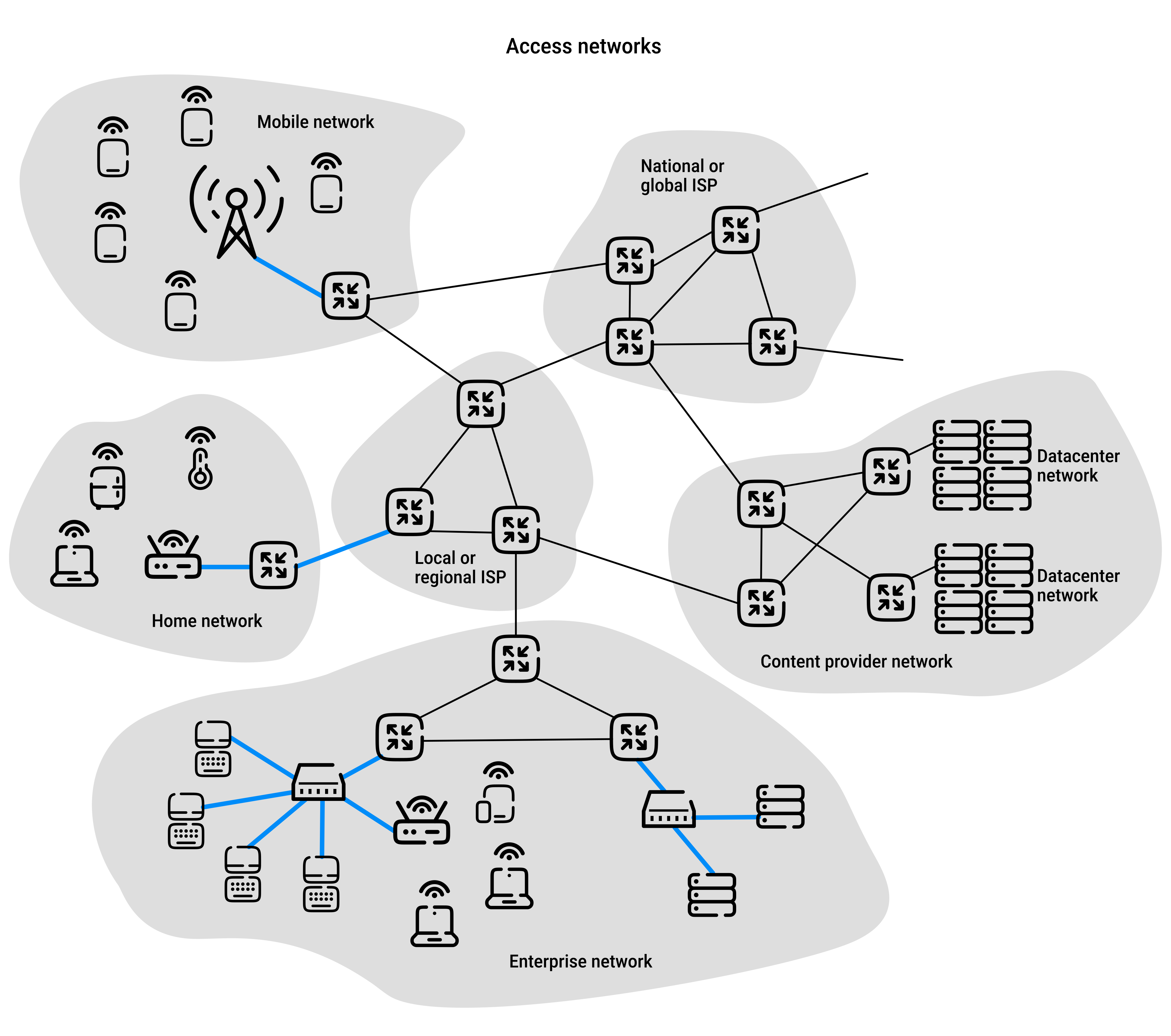
An access network is the portion of the network that connects an end system to the first router (or edge router) that provides access to the Internet backbone.
After that point, traffic enters the core network that carries data between different networks.
Simplified view:
End system → Access network → Edge router → Internet core
Example of different types of access networks (mobile, home, and enterprise):
Home access networks
| Technology | Infrastructure | Customer equipment | Provider equipment | Characteristics | Image |
|---|---|---|---|---|---|
|
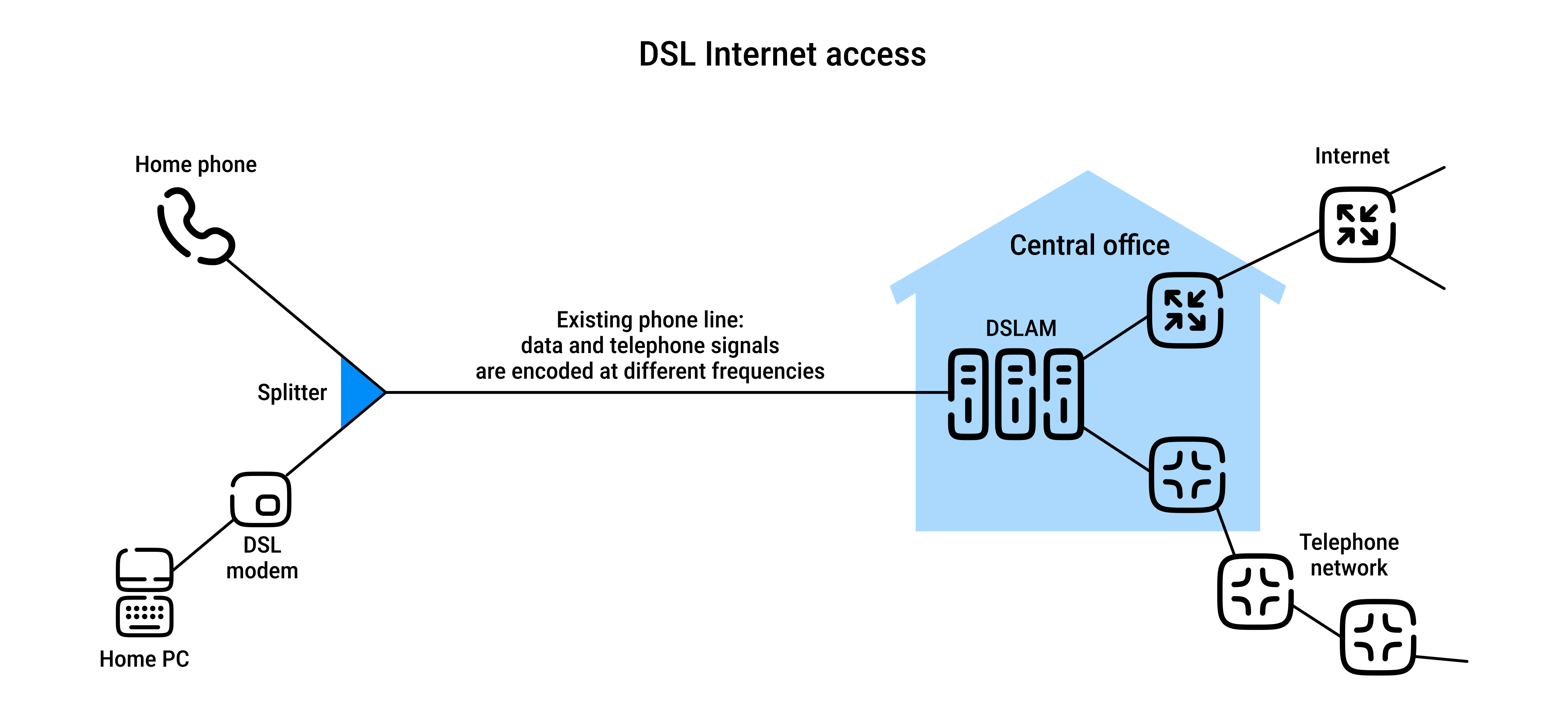
DSL (Digital Subscriber Line) |
Uses existing telephone lines for Internet access. The local telephone company (telco) also acts as the ISP. |
Splitter:
DSL modem:
|
DSLAM (Digital Subscriber Line Access Multiplexer):
|
Internet and telephone services share the same line using frequency-division multiplexing. Data and telephone signals are encoded at different frequencies:
Access is said to be asymmetric because the downstream and upstream rates are different. |
|
|
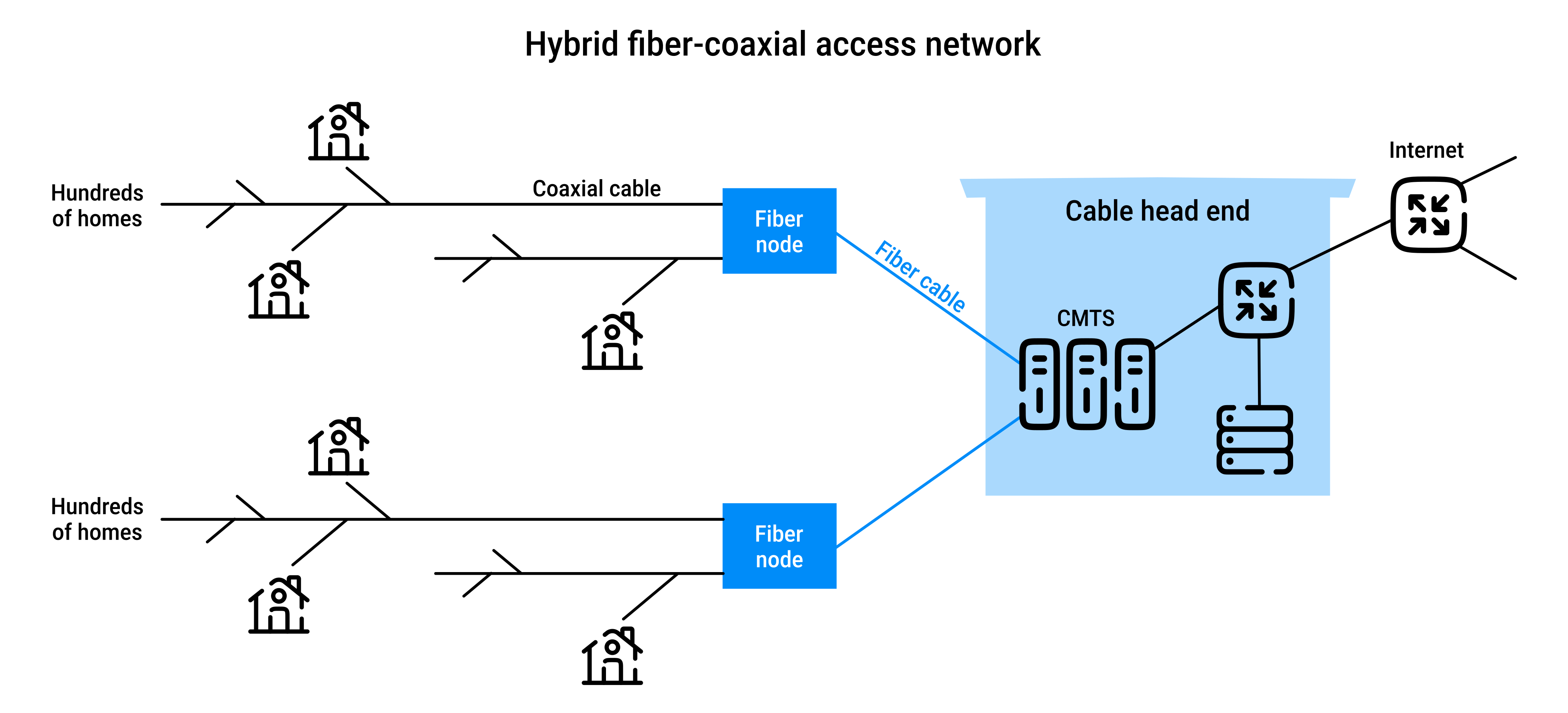
Cable Internet Access |
Uses existing cable television infrastructure. The cable television provider is also the ISP. Uses both fiber and coaxial cable referred to as Hybrid Fiber Coax (HFC). |
Cable modem:
|
CMTS (Cable Modem Termination System):
|
Shared broadcast medium:
|
|
|
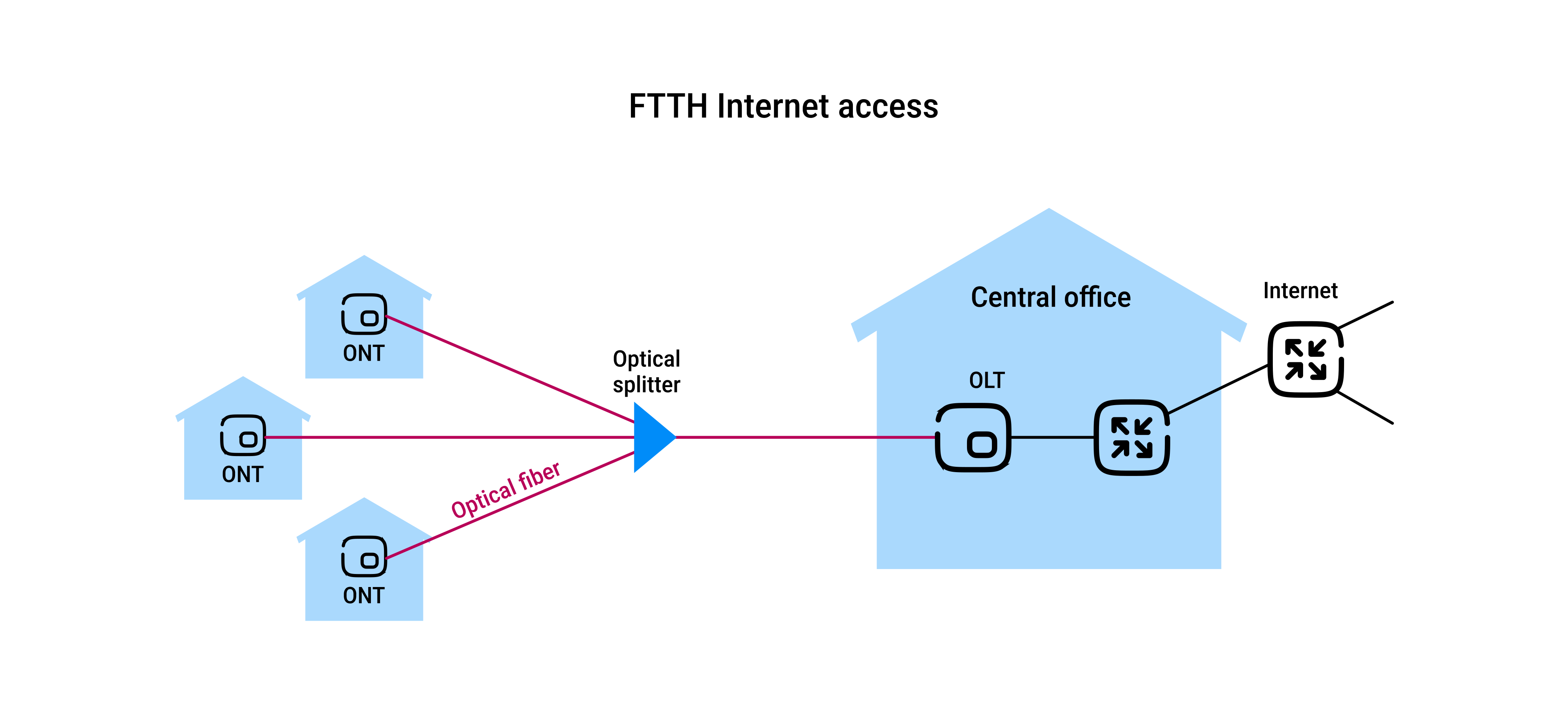
FTTH (Fiber To The Home) |
Delivers optical fiber directly from a Central Office (CO) to homes. Two main types:
|
Optical Network Terminator (ONT):
|
Splitter:
A single shared fiber runs from the splitter to an Optical Line Terminator (OLT) at the CO. OLT:
|
Shared fiber can use two architectures:
|
|
Local area network (LAN)
A LAN (Local Area Network) is a network that connects devices within a small area, such as a home, school, or office.
The LAN is connected to an edge router, which links the local network to the Internet backbone.
Laptop  ─┐
Phone ───┤── LAN → Edge router → Internet
Printer ─┘
The most widely used LAN technologies are Ethernet and Wireless LANs (Wi-Fi).
Wireless wide area network (WWAN)
A WWAN (Wireless Wide Area Network) is a network that connects end systems over a large geographic area using wireless links.
The WWAN uses a mobile network operator's infrastructure to connect devices to an edge router, which provides access to the Internet backbone.
Unlike Wi-Fi networks, which cover short distances within homes or offices, WWAN technologies (e.g., 4G, 5G) provide much wider coverage, often extending across several kilometers or more.
Physical media
Physical media are the channels through which bits are transmitted between devices.
They allow end systems at the network edge to connect to the Internet through access networks.
Categories:
- guided media: signals travel through solid materials (e.g., copper, fiber)
- unguided media: signals travel through air or space (e.g., Wi-Fi, satellite)
Physical wires
| Medium | Material | Physical structure | Speed | Distance | Electromagnetic interference resistance | Cost | Uses | Image |
|---|---|---|---|---|---|---|---|---|
|
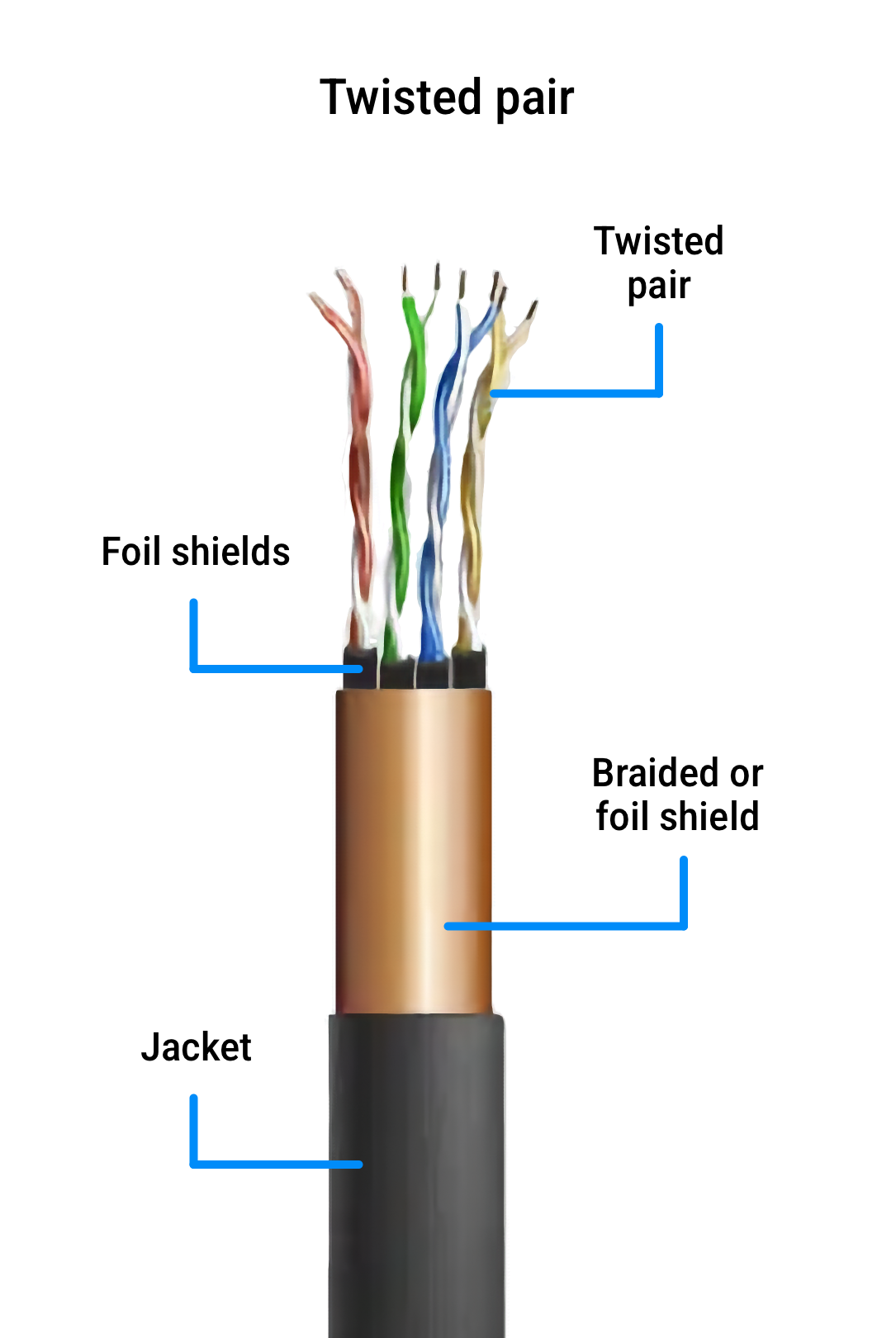
Twisted-pair |
Copper wire |
|
Up to 10 Gbps |
Up to 100 m for LANs |
Low to moderate |
Low |
|
|
|
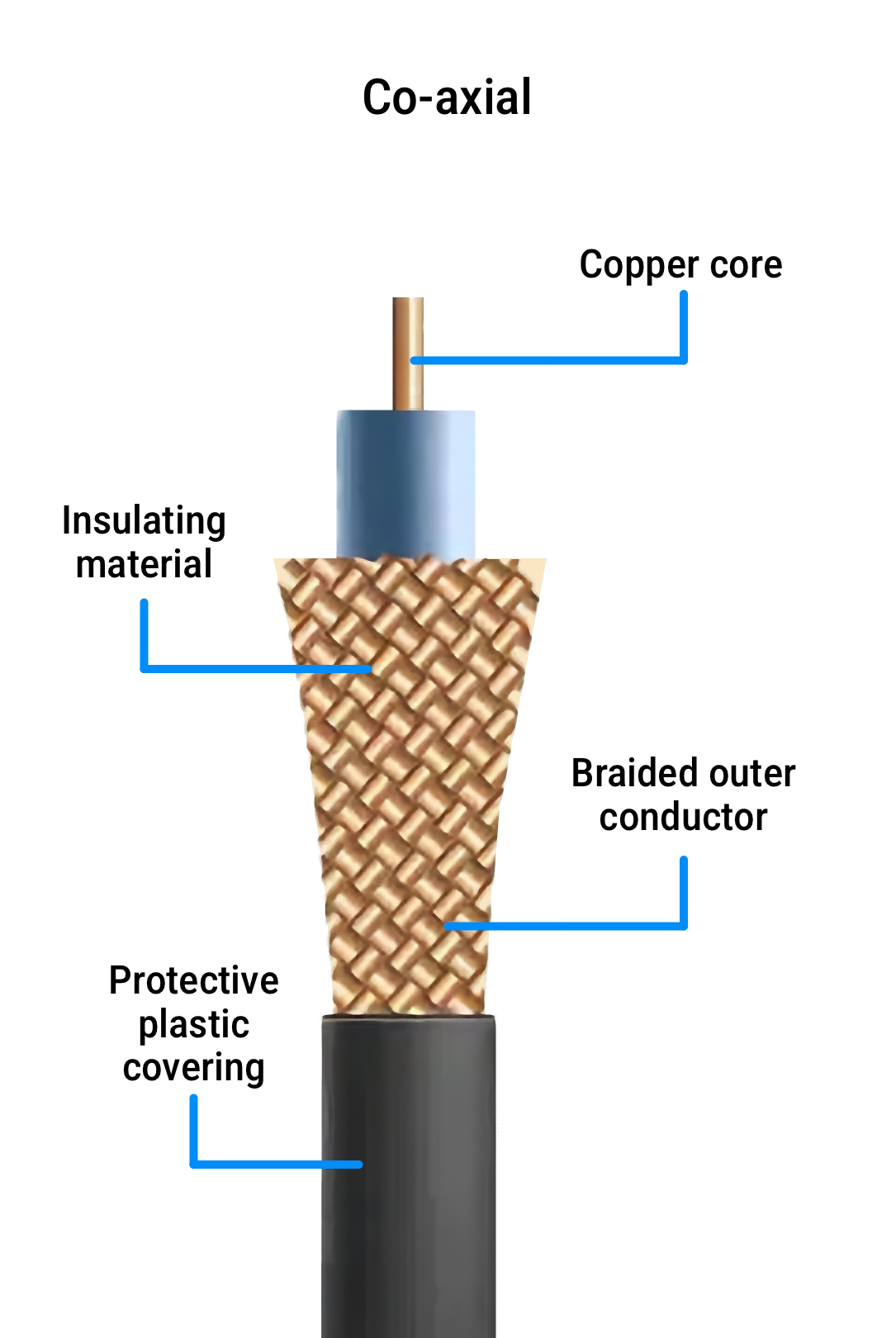
Coaxial cable |
Copper core with shielding |
|
Up to multi-Gbps |
Hundreds of meters or more |
Moderate to high |
Moderate |
|
|
|
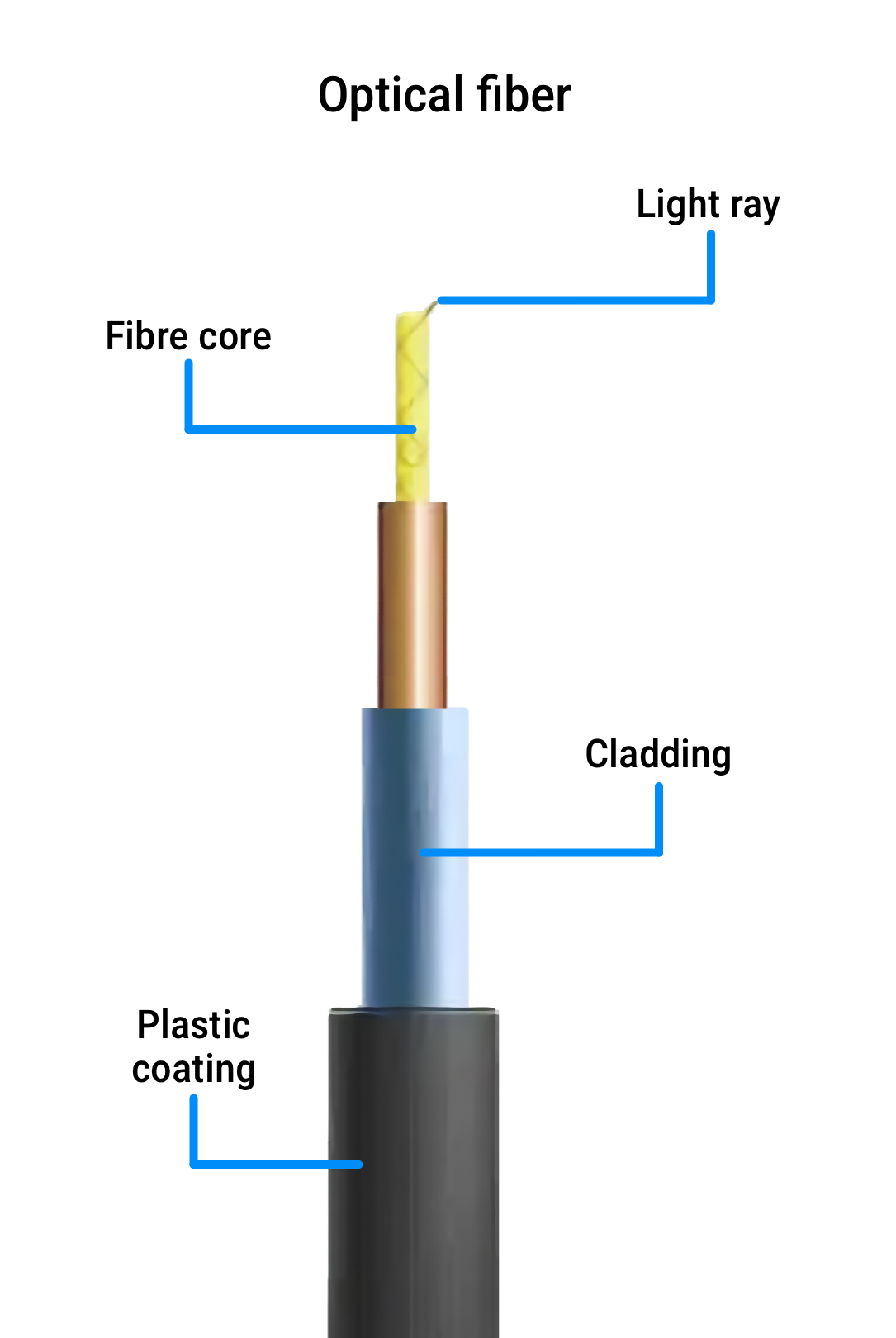
Fiber optics |
Glass or plastic fiber |
|
Very high (Gbps to Tbps) |
Several km to hundreds of km |
Very high (immune to EMI) |
Moderate to high |
|
|
Terrestrial radio channels
Terrestrial radio channels use electromagnetic waves to transmit signals through the air.
Signal quality depends on factors such as distance, frequency, antenna characteristics, and the propagation environment.
Factors affecting performance:
- path loss and shadow fading (signal weakening due to distance and obstacles)
- multipath fading (caused by signal reflections)
- interference (from other signals or transmissions)
Classification by range:
- short-distance (1–2 meters) → wireless headsets, keyboards
- local-area (10–hundreds of meters) → Wi-Fi
- wide-area (tens of kilometers) → cellular networks
Satellite radio channels
Communication satellites use radio/microwave links to communicate between ground stations.
A satellite:
- receives a signal from a ground station on one frequency band
- processes or amplifies the signal using a transponder
- retransmits the signal on another frequency band
Types of communication satellites:
-
geostationary satellites (GEO):
- appear fixed above one point on Earth
- orbit at 36,000 km altitude
- have high latency due to their distance (about 500–600 ms round-trip delay)
- useful in areas without terrestrial broadband access
- support data rates of hundreds of Mbps
-
low-earth orbiting satellites (LEO):
- orbit much closer to Earth and move relative to the surface
- circle the globe many times per day
- can communicate with each other and with ground stations
- require many satellites (a constellation) to provide continuous coverage
 Joint
Joint