Wireless communication impairments
Wireless communication is affected by several factors that can reduce signal quality:
| Impairment | Description |
|---|---|
|
Signal attenuation |
Signal attenuation is the reduction in signal strength as the signal travels. It occurs because:
|
|
Interference |
Interference occurs when unwanted signals overlap with the desired signal in the same frequency band. Examples include:
Many newer 802.11 standards operate in the 5 GHz band because it provides more channels and typically experiences less interference than the crowded 2.4 GHz band. |
|
Multipath propagation |
The electromagnetic wave can bounce off objects or the ground and reach the receiver through different paths. As a result, the received signal becomes distorted due to delayed copies of the transmitted signal arriving at the receiver at different times. |
The receiver obtains an electromagnetic signal that consists of:
- a degraded version of the original signal, affected by attenuation and multipath propagation
- background noise from the environment
Error handling in wireless links
Because wireless links experience more bit errors than wired links, wireless protocols use:
- CRC error detection codes to detect corrupted frames
- link-level reliable-data-transfer protocols to retransmit damaged frames
SNR
The Signal-to-Noise Ratio (SNR) is the ratio of received signal power to noise power:
- expressed in decibels (dB)
- higher SNR means the signal is easier to distinguish from the noise
- therefore, a higher SNR generally leads to more reliable communication
BER
The Bit Error Rate (BER) is the probability that a transmitted bit is received incorrectly:
- lower BER = fewer transmission errors
- higher BER = less reliable communication
Relationship between SNR, BER, and modulation
Different modulation techniques (such as BPSK and QAM16) behave differently depending on the SNR.
BER versus SNR for 3 different physical-layer modulation techniques:
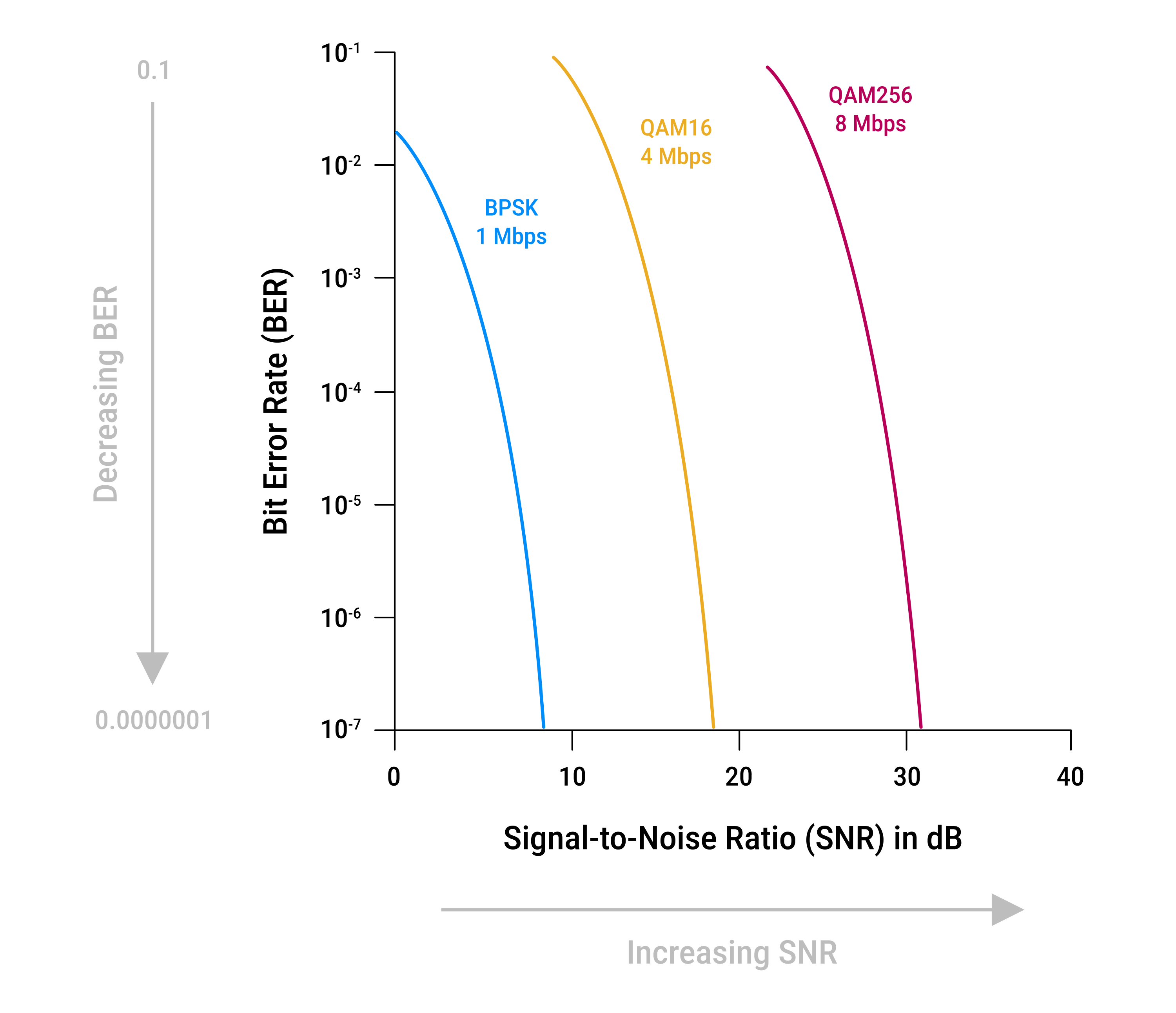
For a given modulation technique (e.g. BPSK):
- as SNR increases, BER decreases
- communication becomes more reliable
- one way to increase SNR is to transmit with more power, but this has disadvantages:
- higher energy consumption
- higher transmit power increases the signal range, making it more likely to interfere with nearby transmissions on the same frequency
For a given SNR:
- higher-speed modulation techniques produce a higher BER
- when SNR = 10 dB
- BPSK (1 Mbps): BER < 10-7 (very reliable)
- QAM16 (4 Mbps): BER ≈ 10-1 (far too many errors for practical use)
- when SNR = 20 dB
- QAM16 (4 Mbps): BER < 10-7 (now reliable enough to use)
- BPSK (1 Mbps): BER is even lower (below the plotted range)
- key idea:
- at low SNR, slower modulation methods are more reliable
- at high SNR, faster modulation methods become practical and provide higher data rates
Adaptive modulation:
- wireless channel conditions change over time (causing the available SNR and achievable BER to vary) due to:
- mobility
- obstacles
- changes in the environment
- wireless systems (including 802.11 Wi-Fi and 4G/5G networks) automatically switch between modulation techniques
- its goal is to maximize the transmission rate while keeping the BER below an acceptable level based on the current channel conditions
 Joint
Joint